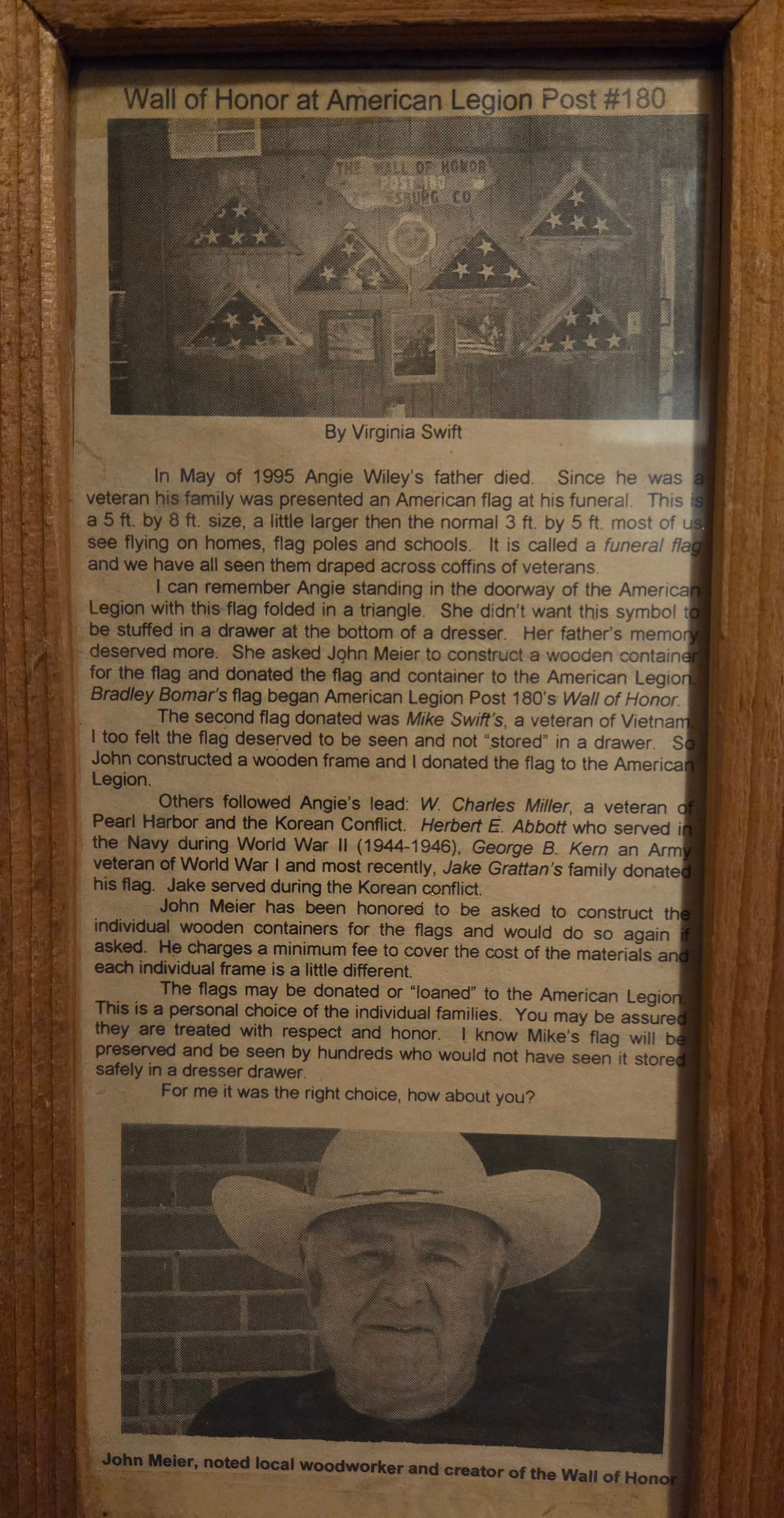
Complete article transcription
Wall of Honor at American Legion Post #180
By Virginia Swift
In May of 1995 Angie Wiley’s father died. Since he was a veteran his family was presented an American flag at his funeral. This is a 5 ft. by 8 ft. size, a little larger then the normal 3 ft. by 5 ft. most of us see flying on homes, flag poles and schools. It is called a funeral flag and we have all seen them draped across coffins of veterans.
I can remember Angie standing in the doorway of the American Legion with this flag folded in a triangle. She didn’t want this symbol to be stuffed in a drawer at the bottom of a dresser. Her father’s memory deserved more. She asked John Meier to construct a wooden container for the flag and donated the flag and container to the American Legion. Bradley Bomar’s flag began American Legion Post 180’s Wall of Honor.
The second flag donated was Mike Swift’s, a veteran of Vietnam. I too felt the flag deserved to be seen and not “stored” in a drawer. So John constructed a wooden frame and I donated the flag to the American Legion.
Others followed Angie’s lead: W. Charles Miller, a veteran of Pearl Harbor and the Korean Conflict. Herbert E. Abbott who served in the Navy during World War II (1944-1946), George B. Kern an Army veteran of World War I and most recently, Jake Grattan’s family donated his flag. Jake served during the Korean conflict.
John Meier has been honored to be asked to construct the individual wooden containers for the flags and would do so again if asked. He charges a minimum fee to cover the cost of the materials and each individual frame is a little different.
The flags may be donated or “loaned” to the American Legion. This is a personal choice of the individual families. You may be assured they are treated with respect and honor. I know Mike’s flag will be preserved and be seen by hundreds who would not have seen it stored safely in a dresser drawer.
For me it was the right choice, how about you?
John Meier, noted local woodworker and creator of the Wall of Honor